
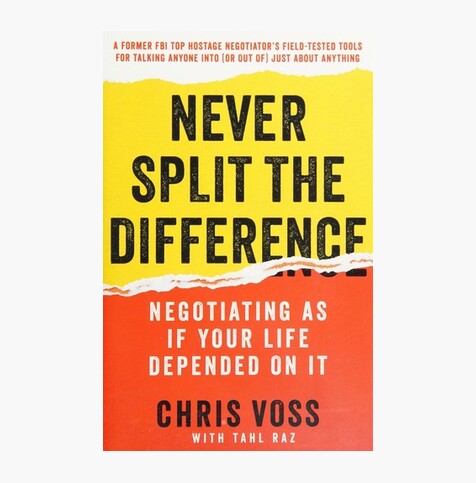
from Chris Voss con Tahl Raz
What makes an FBI negotiator capable of saving lives in kidnappings, and how can you apply those same techniques in your next salary negotiation? Chris Voss, former FBI hostage negotiation chief, revolutionizes everything you thought you knew about negotiation. "Never Split the Difference" isn't about manipulative persuasion tricks; it's about tactical empathy, active listening, and psychological techniques proven in the world's highest-pressure situations.
"Never split the difference. Splitting the difference means both lose." — Chris Voss
BOOK SUMMARY
Voss, with journalist Tahl Raz, transforms decades of experience in life-or-death negotiations into a framework applicable to sales, contracts, salaries, and personal relationships.
The fundamental principles of the book:
1. Tactical empathy: It's not about feeling what the other person feels, but labeling their emotions verbally. Saying "it seems like you're frustrated" reduces emotional tension and creates connection without agreement.
2. Mirroring: Repeating the last 2-3 words of your interlocutor with questioning tone. This simple but powerful technique encourages the other person to expand, revealing valuable information without feeling interrogated.
3. Emotional labeling: Identifying and naming your counterpart's feelings. "It seems like this price concerns you" is more effective than arguing about product features. The human brain seeks emotional connection before logic.
4. "No" as protection: Counterintuitively, seeking "No" instead of "Yes" is more effective. "Is this a terrible idea?" generates less resistance than "Do you agree?". "No" allows the person to feel safe and in control.
5. Calibrated questions: "How" and "What" questions instead of "Yes/No". "How can we make this work?" forces the other party to commit to the solution.
6. "That's right": When your interlocutor says "that's right" (not "you're right"), it means they truly feel you understand them. It's the signal that you've achieved genuine empathy.
7. Black swans: Unexpected information that changes everything. Discovering what's valuable to the other party that you hadn't considered. Money is rarely the only factor.
8. The 10-80 rule: In negotiations, the top 10% gets 80% of the value. Don't settle for "reasonable"; seek the extraordinary.
9. The Ackerman negotiation method: A progressive offer method: (1) set target price, (2) first offer at 65%, (3) increases to 85%, 95%, 100%, (4) use precise numbers, (5) include non-monetary value in final offer.
10. The late night FM DJ voice: A deep, calm tone that projects authority without aggression. Voss teaches using intonation deliberately to influence your interlocutor's emotional state.
WHY I RECOMMEND READING THIS BOOK? By Francisco Santolo
This book fundamentally changed how I approach difficult conversations. Voss demonstrates that negotiation isn't a zero-sum game where you win or they win; it's a joint discovery process where both can come out better.
I especially recommend his focus on genuine listening. Most people "listen" waiting for their turn to speak. Voss teaches listening to understand underlying emotions: fear, anxiety, desire to be valued. When you correctly label those emotions, something magical happens: resistance decreases, collaboration increases.
The concept of seeking "No" instead of "Yes" was revelatory. My whole life I was trained to get "yes" —"Would you like to buy?" "Do you agree?". Voss demonstrates this generates resistance. Asking for "no" —"Is this crazy?" "Would that be impossible?"— lowers defenses and allows exploring options.
His voice techniques are practical and immediately applicable. The "late night FM DJ voice" (deep, calm tone) projects authority without threat. "Mirroring" (repeating the last words) is so simple it sounds ridiculous, until you try it and see how people open conversations they previously closed.
For anyone negotiating contracts, salaries, sales, or even personal relationships, this book offers an ethical and effective framework. It's not about manipulation; it's about genuine human connection that enables better agreements for everyone.
RELATED BOOKS
"Influence: The Psychology of Persuasion" by Robert Cialdini
The scientific principles behind persuasion that Voss applies intuitively. Cialdini provides the academic research.
"Getting to Yes" by Roger Fisher and William Ury
The classic Harvard negotiation book. More theoretical than Voss, but complementary on fundamental principles of mutual agreements.
"Exactly What to Say" by Phil M. Jones
Specific phrases for difficult sales and negotiation moments. More tactical and less deep than Voss, but practical.