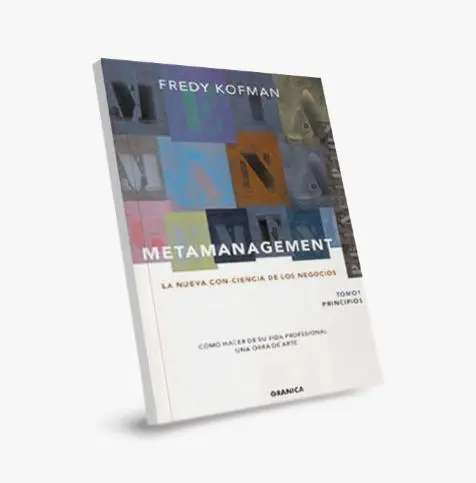
Metamanagement by Fred Kofman is a monumental work that redefines business management through consciousness. Across three volumes spanning philosophy, psychology, linguistics, and managerial practice, Kofman proposes that true professional effectiveness is born from unconditional responsibility, authentic communication, and the ability to integrate economic success with personal meaning. It is not a book of management techniques: it is a treatise on how to be a whole human being in the context of work.
“The problem is never the problem. The problem is how you relate to the problem.” — Fred Kofman
BOOK SUMMARY
Kofman organizes Metamanagement around a central concept: unconditional responsibility. Instead of blaming circumstances, the market, or others, the conscious leader assumes they always have the ability to respond to any situation. It is not about blame but about agency: choosing to be a player rather than a victim.
Authentic communication: Kofman distinguishes between “controlling” communication (where one tries to impose their truth) and “learning” communication (where one shares their perspective and genuinely inquires into others’). This distinction transforms meetings, negotiations, and everyday conflicts.
Mental models: Following Peter Senge’s line of thought, Kofman delves into how our invisible assumptions determine what we see, what we decide, and what we achieve. Making those models conscious is the first step to changing them.
Constructive negotiation: Instead of a win-lose approach, Kofman proposes negotiation where parties seek to create joint value. This requires distinguishing between positions (what each side asks for) and interests (what each side actually needs).
Emotions as information: Far from viewing them as obstacles, Kofman treats emotions as essential data for decision-making. Emotional intelligence is not about suppressing what we feel but processing it with awareness and using it to act with clarity.
The book is dense, academic, and deeply practical at the same time. Kofman does not offer easy recipes: he offers thinking frameworks that, once internalized, change how one operates in any organization. His influence extends from startups to global corporations —he served as leadership coach at LinkedIn and advisor to Satya Nadella at Microsoft.
Metamanagement is a book I first read during university and returned to several times as I approached —and when I became— Marketing Manager at age 26. It was of incredible value during that formative stage and remains so today. Kofman is one of the thinkers who has most influenced how I understand leadership and management. It is not a book you read once: it is a book you return to every time you face a complex situation, a conflict with a partner, a difficult negotiation, or a crisis of professional meaning.
What I value most is his concept of unconditional responsibility. In the entrepreneurial world it is too easy to fall into victimhood: the market doesn’t understand, the investor doesn’t see it, the team doesn’t deliver. Kofman cuts that at the root. If something isn’t working, the question is not “whose fault is it?” but “what can I do differently?” That single distinction changes everything.
At Scalabl® we have incorporated many of his principles, especially the distinction between controlling and learning communication. When a team learns to share their thinking without imposing it and to inquire into others’ thinking without judging it, the quality of decisions multiplies. It is not motivation: it is a concrete technique that produces measurable results.
What sets Kofman apart from other management authors is his deeply humanistic approach. His work is not just about being more effective: it is about caring for people and respecting life itself within the context of work. The role of genuine listening, of putting oneself in the other person’s shoes, of understanding before judging, runs through every chapter. In a corporate world that often prioritizes results over people, Kofman demonstrates that both are inseparable.
I also find it brilliant how he connects philosophy with business practice without it feeling forced. Kofman can quote Sartre and in the next paragraph show how that applies to a board meeting. That ability to bridge the profound and the operational is rare and very valuable.
It is a demanding book. It cannot be read quickly or applied overnight. But whoever internalizes it operates at a different level —as a leader, as a negotiator, and as a person.
Reading is the beginning. Applying is the leap.
At Scalabl you don't stop at the summary: you take the best business ideas to your own venture. Our flagship Entrepreneurship & Innovation Course: 10 years running, graduates in 50+ countries, 12 modules at your own pace.