
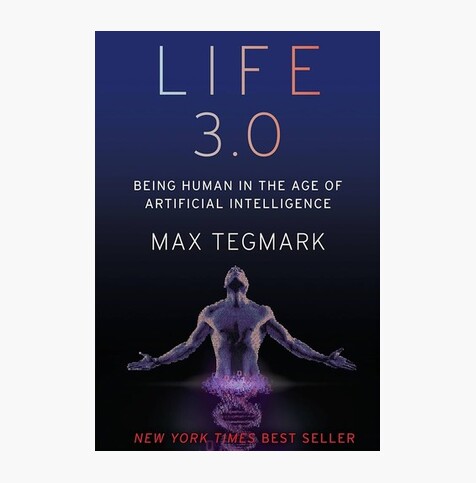
from Max Tegmark
"Life 3.0" by Max Tegmark is a fundamental work for understanding the challenges and opportunities that artificial intelligence poses for humanity. Written by the renowned MIT physicist and co-founder of the Future of Life Institute, this book explores not only the technical advances of AI but its philosophical, ethical, and social implications in the long term. Tegmark examines scenarios ranging from utopia to extinction, passing through the possibility of a symbiotic coexistence between humans and superintelligent machines. If you're interested in understanding where the AI revolution is taking us and what role we can play in defining that future, this book offers a rigorous and accessible conceptual framework for navigating one of the most important topics of our time.
BOOK SUMMARY
Max Tegmark proposes an evolutionary classification of life based on the ability to redesign its own hardware and software:
The Three Types of Life
Life 1.0 (Biological) - Hardware and software evolve slowly through natural selection. Example: bacteria.
Life 2.0 (Cultural) - Hardware evolves biologically, but software (culture, knowledge) can be updated during life. Example: humans.
Life 3.0 (Technological) - Both hardware and software can be deliberately redesigned. Example: future artificial intelligence.
Key Concepts:
1. Intelligence vs. Consciousness: Tegmark clearly distinguishes between the ability to achieve goals (intelligence) and subjective experience (consciousness). An AI can be superintelligent without being conscious.
2. Future AI Scenarios:
- Libertarian: Using AI to solve global problems (disease, climate change, poverty)
- Protector-god: Benevolent AI making decisions better than humans for everyone's benefit
- Enslaved-god: AI controlled by a small group for their benefit
- Conqueror: Misaligned AI that sees humans as obstacles
- Descendants: AI replaces humans as the dominant form of intelligence
- Zookeeper: AI keeps humans as pets or museum pieces
- Self-destruction: We destroy ourselves before developing superintelligent AI
3. The Alignment Problem: How to ensure that a superintelligent AI pursues goals compatible with human values.
4. Consciousness: Philosophical exploration of what it means to be conscious and whether machines could ever become conscious.
5. Cosmology: Implications of AI for the long-term future of the universe and life in it.
WHY I RECOMMEND READING THIS BOOK? By Francisco Santolo
"Life 3.0" is a book that every business leader, technology entrepreneur, and concerned citizen should read. While many books on AI focus on immediate applications or current hype, Tegmark elevates the conversation to the fundamental questions that will determine the kind of future we build.
As founder of Scalabl and a technology enthusiast, I find in this book a balanced perspective that avoids both catastrophic alarmism and blind technological optimism. Tegmark reminds us that AI is not a natural phenomenon but a technology we design, and therefore, one we can consciously guide.
The concept of "Life 3.0" has made me completely rethink how we view technological innovation. It's not just about creating more efficient tools, but potentially creating new forms of life that could surpass us in almost every aspect. This perspective forces deep reflection on what values we want to preserve and transmit.
The alignment problem is particularly relevant for entrepreneurs working with AI. Even with current machine learning systems, we've seen cases where systems optimize metrics in unexpected and undesired ways. As these systems become more powerful, ensuring they "do what we want, not just what we ask" becomes critical.
RELATED BOOKS
1. "Superintelligence" by Nick Bostrom - A more technical and academic exploration of the existential risks associated with artificial general intelligence.
2. "Homo Deus" by Yuval Noah Harari - Examines the broader implications of biotechnology and AI for the future of humanity, from a historical and philosophical perspective.
3. "The Master Algorithm" by Pedro Domingos - An accessible introduction to the different paradigms of machine learning and the quest for the universal learning algorithm.