
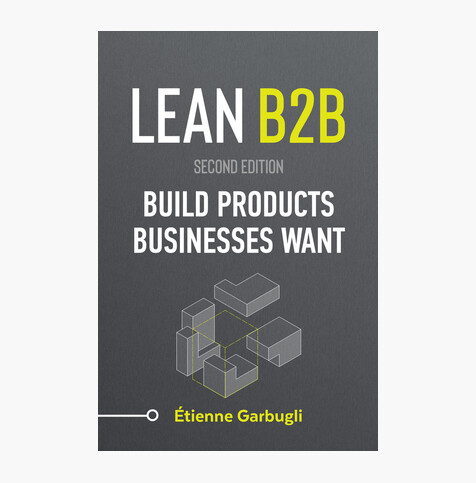
from Étienne Garbugli
Lean B2B by Étienne Garbugli is the definitive guide for B2B entrepreneurs seeking to apply Lean Startup principles in the complex world of business-to-business sales. This book addresses one of entrepreneurship's biggest challenges: how to validate B2B products when your customers are organizations with multiple stakeholders, long sales cycles, and complex purchasing processes. Garbugli, an expert in customer development and product management, provides a practical framework based on his real experience working with B2B startups and established companies. The book has been acclaimed as required reading for anyone trying to sell to businesses, offering specific tactics for finding first enterprise customers, validating complex problems, and building products that organizations actually want to buy. If you're building a B2B startup or innovating within a company, Lean B2B gives you the roadmap to navigate the peculiarities of the enterprise market without wasting resources on products nobody needs.
BOOK SUMMARY
Étienne Garbugli adapts Lean Startup and Customer Development principles to the specific context of B2B businesses, where validation is more complex than in the consumer world. The book is structured as a field manual that guides the reader from problem identification to solution validation.
1. Understanding the B2B Context
Garbugli begins by establishing why B2B is different from B2C:
2. The Lean B2B Process
Phase 1: Problem Discovery
Before building any solution, the entrepreneur must validate that a valuable problem exists:
Phase 2: Problem Validation
Phase 3: Solution Validation
Phase 4: Product Validation
3. Key B2B Customer Development Tactics
Effective discovery interviews:
Enterprise early adopters:
Commitment validation:
Key Additional Concepts:
WHY I RECOMMEND READING THIS BOOK? By Francisco Santolo
Lean B2B is one of those books that would have saved months of pain in my first B2B startups. What makes Garbugli special is that he doesn't repeat generic Lean Startup mantras, but focuses specifically on the complexities of the enterprise world that other authors ignore.
The concept of "hair on fire problem" transformed how I evaluate opportunities. In B2B, it's not enough for your product to be "better" — it needs to solve something that causes real and measurable pain in the organization. If the problem isn't urgent enough for someone to risk their reputation promoting it internally, you don't have a business.
What I value most are the practical tactics for interviews and validation. The "problem before solution" approach is counterintuitive but crucial. I've seen too many B2B entrepreneurs lose months building products nobody asked for because they assumed they knew the problem without validating it with the market.
The section on enterprise early adopters is pure gold. Finding those first companies willing to take a chance on a startup is one of the biggest challenges, and Garbugli gives concrete strategies to identify and convert them into customers.
I also appreciate that he addresses the reality of long sales cycles and multiple stakeholders. In B2B, a sale isn't a transaction — it's an organizational navigation process that requires patience and strategy.
If you're building something for businesses, read this book before writing the first line of code. It can save you years of work in the wrong direction. It's dense with actionable advice, so take notes and apply each concept before moving to the next.
RELATED BOOKS
1. The Lean Startup - Eric Ries
The foundational book that inspired Garbugli. Essential for understanding the general Lean Startup principles that are specifically applied to the B2B context in this book.
2. The Mom Test - Rob Fitzpatrick
The definitive manual on how to talk to customers and learn if your business is a good idea. Perfectly complements Garbugli with deeper discovery interview techniques.
3. Crossing the Chasm - Geoffrey Moore
The classic on how to take technology products from early adopters to mass market. Especially relevant for B2B when it's time to scale beyond the first innovative customers.