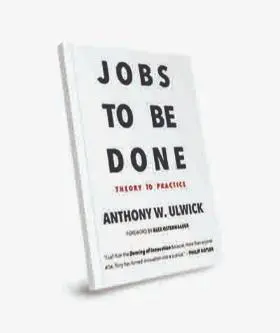
Jobs to Be Done by Anthony Ulwick presents one of the most rigorous and actionable frameworks for understanding innovation from the customer’s perspective. The book starts from a fundamental premise that shifts the traditional focus of product development: companies should not focus on what they sell, but on what customers are actually trying to accomplish. Ulwick argues that successful innovation begins when companies clearly understand the “jobs” customers are trying to get done—defined not as simple tasks, but as stable functional objectives that exist independently of available solutions. This perspective enables organizations to redefine markets, identify real growth opportunities, and dramatically reduce the risk of innovation.
“Customers don’t buy products; they hire them to get a job done.” — Anthony Ulwick
BOOK SUMMARY
The book begins by establishing the foundations of the Jobs to Be Done framework, shifting the focus away from products, categories, or traditional segments toward the objectives customers seek to achieve. Ulwick explains that while technologies and solutions change over time, the jobs people are trying to accomplish remain remarkably stable. This stability becomes the basis for more predictable and sustainable innovation.
A central concept in the book is Outcome-Driven Innovation (ODI). This approach proposes systematically identifying the outcomes customers want to achieve when performing a job and evaluating two key variables: the importance of each outcome and the level of satisfaction with existing solutions. By quantifying these dimensions, companies can identify clear innovation opportunities by focusing on important outcomes that are currently underserved.
Ulwick emphasizes that this approach goes far beyond traditional market research. Instead of asking customers which features they want, the methodology focuses on understanding how customers measure success when trying to complete a job. This enables organizations to more accurately predict which innovations will succeed in the market, turning innovation into an analytical and repeatable process.
The book also addresses the role of context and job drivers, recognizing that customer decisions are influenced by constraints, circumstances, and specific evaluation criteria. While the core of the framework is functional, Ulwick acknowledges that contextual factors affect when and how customers choose one solution over another.
Ulwick is critical of traditional innovation approaches based on unstructured brainstorming or demographic segmentation. He argues that these methods often produce ideas disconnected from real customer needs. In contrast, the Jobs to Be Done framework offers a clear architecture of needs, expressed as desired outcomes, that can be discovered, measured, prioritized, and used as the foundation for strategic decision-making.
Finally, the book guides readers on how to implement Jobs to Be Done within organizations, integrating this approach into product development, strategy, and innovation processes. By doing so, companies can build stronger competitive advantages that are less dependent on intuition or luck.
I recommend Jobs to Be Done because it is one of the books that best transforms innovation into a disciplined process focused on real customer learning. Rather than promoting directionless creativity, Ulwick provides a framework that forces teams to understand the problem first, before designing the solution.
From my experience, many ventures and organizations fail not due to a lack of ideas, but because they build products that do not clearly help customers achieve what they truly want. This book addresses that issue at its root, forcing a reversal of the traditional order: first understand the job, then design the value proposition, and only afterward think about execution and scale.
At Scalabl®, we work with the idea that businesses exist within value networks, and that innovation occurs when an organization helps the different actors in the system better achieve their goals. Ulwick’s approach fits perfectly with this vision: jobs are the minimum unit of meaning upon which strong business models are built.
I particularly value that this book does not promise inspiration, but predictability. It does not eliminate uncertainty, but it significantly reduces risk by grounding innovation in stable, measurable, and prioritizable needs. For entrepreneurs, intrapreneurs, and leaders, this represents a substantial strategic advantage.
In short, Jobs to Be Done is a foundational read for anyone seeking to innovate with less intuition and deeper customer understanding. It is not a trendy book—it is a conceptual framework that continues to grow in relevance over time.
Reading is the beginning. Applying is the leap.
At Scalabl you don't stop at the summary: you take the best business ideas to your own venture. Our flagship Entrepreneurship & Innovation Course: 10 years running, graduates in 50+ countries, 12 modules at your own pace.
Anthony Ulwick As an earlier work by Ulwick, this book lays the groundwork for the principles detailed in Jobs to Be Done. It provides a comprehensive understanding of Outcome-Driven Innovation, making it an invaluable resource for those looking to master Ulwick’s approach to innovation and product development.
Demand-side Sales 101Bob Moesta
Demand-side Sales 101
Bob Moesta
Bob Moesta This book complements Ulwick’s Jobs to Be Done approach by exploring how sales can be driven through a deeper understanding of customer needs. Moesta, a collaborator of Christensen, offers practical insights on aligning sales strategies with the jobs customers are trying to accomplish, making it a crucial read for anyone interested in customer-centric sales approaches.
Let's talk
Leave your details and the team will contact you.
📚
LucíaBusiness Library · Scalabl®
What is your name? What are you looking to learn these days?