
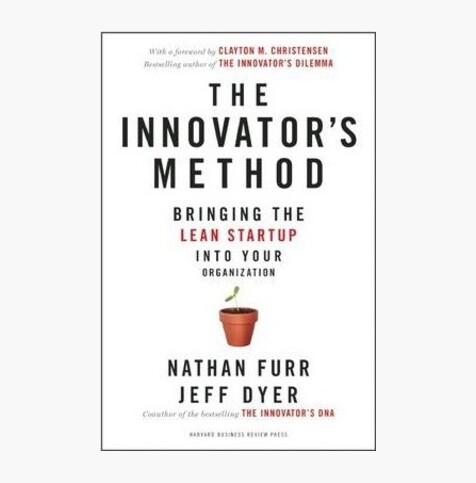
from Nathan Furr; Jeff Dyer
The Innovator's Method by Nathan Furr and Jeff Dyer represents the definitive bridge between the agile world of startups and traditional corporate structures. In an era where disruption is the norm rather than the exception, this practical manual demonstrates that innovation is not a divine gift granted to a chosen few, but a systematic process that can be taught, learned, and replicated in any organization. Furr and Dyer, both prestigious academics with experience as entrepreneurs, combine decades of research with real cases of companies that have successfully transformed their culture to compete in uncertain markets.
BOOK SUMMARY
The book presents a four-step framework that enables companies to develop disruptive innovations in a predictable and scalable way:
1. Insights
Innovation begins with deep customer observation. It's not about mass surveys, but developing the ability to detect unsolved problems, silenced frustrations, and unarticulated desires. The authors teach "customer discovery" techniques that go beyond traditional marketing.
2. Problem-Solution Fit
Before building any product, it's essential to validate that we're solving a real problem that customers are willing to pay to solve. This step includes creating "value experiments" that test critical hypotheses with minimal resources.
3. Product-Market Fit
Once the problem is validated, the challenge is to build a solution that customers actually adopt. The authors introduce engagement metrics and pivoting techniques that allow for rapid iteration until finding the right formula.
4. Business Model Fit
The final phase involves scaling the innovation by creating a sustainable business model. Here they explore how to capture value, define distribution channels, and structure the organization to support growth.
Additional key concepts:
WHY I RECOMMEND READING THIS BOOK? By Francisco Santolo
As founder of Scalabl, I've seen too many companies fall into the trap of believing that innovation is a matter of luck or hiring "creative people." This book dismantles that dangerous myth. Innovation is a process that can be managed, but it requires methodologies completely different from traditional operational management.
What I value most about Furr and Dyer is that they don't stop at theory. They present concrete tools that I've seen work in both startups and corporations seeking to transform themselves. The concept of "minimum critical problem" changed my way of evaluating business opportunities.
For entrepreneurs, this book is a survival manual: it prevents you from spending months building something nobody wants. For corporate executives, it's a transformation guide: it shows how to create "islands of innovation" within structures designed for efficiency, not experimentation.
In the Scalabl ecosystem, we apply these principles daily. Every startup we accompany goes through these four stages, and the results speak for themselves: companies that follow the method innovate faster, with fewer resources, and with higher probability of success.
RELATED BOOKS
1. [The Lean Startup](../lean_startup/) by Eric Ries - The theoretical foundation upon which Furr and Dyer build their methodology applied to corporations.
2. [Business Model Generation](../business_model_generation/) by Alexander Osterwalder - Perfect complement for designing and validating innovative business models.
3. [The Innovator's Dilemma](../innovators_dilemma/) by Clayton Christensen - The strategic context that explains why large companies need radically different innovation methods.