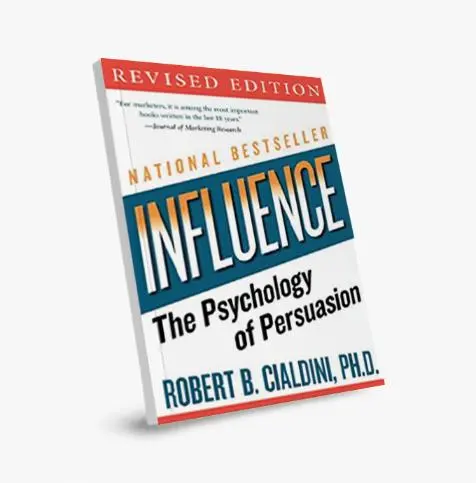
"Influence: The Psychology of Persuasion" by Robert Cialdini is the definitive study on how and why we say "yes." Originally published in 1984 and updated several times, it's the result of decades of research in social psychology and undercover experiences where Cialdini trained himself in the persuasion techniques used by salespeople, advertisers, fundraisers, and cults. The book identifies six universal principles that activate automatic compliance responses in human beings.
"The key, the distinctive feature of automated influence, is the perceived vulnerability of the subject. Persuasion professionals don't create our motivations; they simply channel them toward their objectives." - Robert Cialdini
BOOK SUMMARY
Cialdini discovered that humans develop mental shortcuts to navigate a complex world. These shortcuts work most of the time, but can be exploited by those who understand how to activate them. The six principles of influence are:
1. Reciprocity: We feel a deep obligation to return favors, gifts, invitations, and concessions. Cialdini documents how even unsolicited gestures (like the free mint at a restaurant) drastically increase compliance. The "door-in-the-face" strategy works because an initial rejection generates a sense of debt that is paid by accepting a second, smaller request.
2. Commitment and Consistency: Once we take a position or make a promise, we feel personal and interpersonal pressure to behave consistently with that commitment. Salespeople use techniques like obtaining small prior agreements ("if I had the color you're looking for, would you buy it?") that increase the probability of subsequent purchase.
3. Social Proof: When we're uncertain, we look to others to determine what's correct. This shortcut is particularly powerful when the "others" are similar to us. Ads that say "best-selling product" or "9 out of 10 doctors recommend" activate this principle.
4. Authority: We tend to obey authority figures, even when the authority is superficial (titles, clothing, badges). Cialdini documents Milgram's experiment where ordinary people applied "lethal" electric shocks simply because a man in a white coat ordered them to.
5. Liking: We prefer to say yes to people we like. Liking can be generated by physical attractiveness, similarity (tastes, origin, opinions), sincere compliments, cooperation toward common goals, and association with positive things.
6. Scarcity: Opportunities seem more valuable when their availability is limited. Exclusivity, competition for a scarce resource, and potential loss (more powerful than potential gain) activate irrational urgency responses.
Cialdini also proposes a defense: awareness. By being conscious of these mechanisms, we can recognize when they're being used against us and make decisions based on real merit, not on psychological shortcuts.
This book is essential for any entrepreneur because it shows you two things simultaneously: how to be more effective at communicating your value and how to protect yourself from manipulation. Cialdini wrote from an ethical perspective -he wants us to understand these mechanisms to use them honestly and defend ourselves from those who use them against us.
I especially recommend it because startups live or die by their ability to persuade. You need to convince customers, investors, employees, and partners. And in every interaction, you're navigating these principles, consciously or unconsciously. Understanding them gives you a structural advantage.
These principles are constantly applicable: reciprocity (giving value before asking for anything), social proof (success stories), authority (results and proven methodology), and scarcity (programs with limited spots). But they must be used with integrity: the promised value must be real.
What impacted me most was the principle of commitment and consistency. If you can get someone to take an initial small public commitment -attend a webinar, complete a survey, try a free product- the probability that they'll take larger commitments increases exponentially. It's basic psychology, but few use it strategically.
This book makes you a better salesperson, better negotiator, better leader, and better consumer. It allows you to recognize when you're being pushed toward a decision that isn't yours, and gives you tools to influence others ethically.
Reading is the beginning. Applying is the leap.
At Scalabl you don't stop at the summary: you take the best business ideas to your own venture. Our flagship Entrepreneurship & Innovation Course: 10 years running, graduates in 50+ countries, 12 modules at your own pace.