
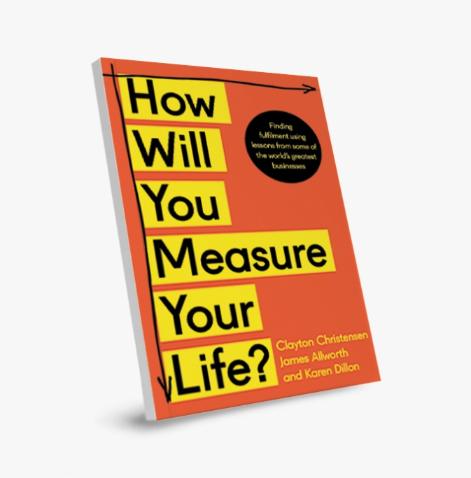
from Clayton Christensen, James Allworth, and Karen Dillon
"How Will You Measure Your Life?" by Clayton Christensen, James Allworth, and Karen Dillon is the most personal book from the author of "The Innovator's Dilemma." Born from a 2010 Harvard commencement speech Christensen gave while battling the same cancer that had killed his father, the book applies the business theories Christensen developed over decades to life's most important decisions: career, family, and integrity.
"It's not mortality that worries me. It's reaching the end of life and realizing I didn't live the life I wanted to live." — Clayton Christensen
BOOK SUMMARY
Christensen structures the book around three fundamental questions every professional should ask themselves:
QUESTION 1: How can I ensure I find satisfaction in my career?
Herzberg's motivation theory distinguishes between hygiene factors (salary, conditions) and motivators (learning, recognition, responsibility). Christensen discovered that most of his Harvard classmates prioritized hygiene factors (money, status) over motivators, and ended up unhappy despite external success.
The right strategy:
Money is a hygiene factor: below a certain threshold it causes unhappiness, but above it doesn't cause happiness. Satisfaction comes from growth and purpose.
QUESTION 2: How can I ensure my personal relationships are sources of lasting happiness?
Christensen applies the resource-based theory of business strategy to personal relationships:
Have a strategy for your life: Most people don't. They go with the flow. As in business, you need clarity of purpose.
Allocate resources: Your time and energy are finite. Christensen observed that his Harvard classmates, when they had a free hour, dedicated it to activities with immediate impact (work) rather than investing in long-term relationships (family). The result: professional success, personal failure.
Create family culture: Successful families, like successful companies, have clear cultures: shared values, defined priorities, instinctive procedures. Don't let "the urgent" destroy "the important".
The mistake of "100% of new opportunities": Many professionals apply marginal opportunity analysis to their relationships: "I can miss this birthday, it's just once." But relationships are built with consistency, not with sporadic grand gestures.
QUESTION 3: How can I avoid compromising my integrity?
The most powerful chapter of the book. Christensen warns about the trap of "marginal reasoning":
The trap of marginal cost: In finance, the marginal cost of producing one more unit can be lower than the average cost. This works for economic decisions. But it's catastrophic for ethical decisions.
"Just this once" seems harmless. But every time you cross an ethical line, you lower your threshold for the next time. What started as "just a small exaggeration on my CV" can end in fraud. What started as "just a little gift" can end in bribery.
Decide who you want to be before facing temptation: Christensen cites Dostoevsky: "If there is no God, everything is permitted." His secular version: "If there are no unbreakable principles, everything is negotiable." Decide your red lines before you're tested.
The "mud" in the crucible: The worst ethical acts usually aren't conscious decisions; they're the result of many small justifications. "Everyone does it," "no one will find out," "it's for the company's good." Each justification is a shovelful of mud that clouds your judgment.
WHY I RECOMMEND READING THIS BOOK? By Francisco Santolo
This book is a letter from a man who knows he's dying to those who still have time. Christensen wrote from the vulnerability of his illness, and that gives it an urgency conventional self-help books lack. He's not selling happiness; he's sharing accumulated wisdom.
I especially recommend it because it connects business and life deeply, not superficially. Many "work-life balance" books are vague and generic. Christensen uses the same tools we use to analyze companies—strategy, resource allocation, motivation theory—to analyze our lives. It's rigorous application, not forced analogy.
The concept of resource allocation is brutally honest. Saying "my family is the most important thing" while spending 12 hours daily at work is a lie you tell yourself. Christensen forces confrontation of the discrepancy between what we say we value and where we put our time. Time doesn't lie.
The section on integrity is essential. Christensen warns that exceptions become rules. Many talented people destroy their careers not with one big bad decision, but with accumulated small justifications: "it's just this once," "everyone does it," "it's an exception." Decide who you are when it doesn't cost, because when it does, it will be too late.
At Scalabl we try to apply these lessons. We created a company where personal growth is as important as professional growth. We challenge our team to think about their life strategy, not just their career strategy. And we talk openly about integrity: there is no "just this once," no exceptions for results.
The final message is simple but profound: the metrics you use to measure your success will determine your life. If you only measure money and status, you'll optimize for that. If you measure relationships, growth, and impact, you'll optimize for that. Choose your metrics wisely, because you will become them.
This book is required reading for anyone who has ever wondered "what am I working so hard for?" after a 14-hour day. Christensen's answer: work hard, but work on the right things.
RELATED BOOKS
"The Effective Executive" by Peter Drucker
The classic on time management and priorities. Complements Christensen with the focus on personal effectiveness as the foundation of success.
"Essentialism" by Greg McKeown
The philosophy of "less but better" applied to life and work. McKeown expands Christensen's resource allocation idea with practical tactics.
"Meditations" by Marcus Aurelius
The reflections of the philosopher-emperor on virtue, purpose, and the good life. The historical connection to Christensen's fundamental question: how will you measure your life?