
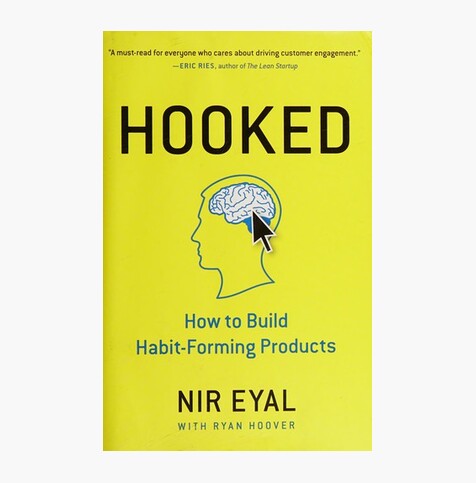
from Nir Eyal
Hooked by Nir Eyal is the definitive manual for understanding how technology products create habits in their users. This revolutionary book reveals the psychology behind the world's most addictive apps and services, from Instagram to TikTok, providing a practical framework that any entrepreneur or product manager can apply. Eyal, an expert in behavioral psychology and product design, presents the "Hook" model, a four-step cycle that explains how products go from occasional to becoming indispensable habits. The book has been adopted by Silicon Valley startups, large corporations, and entrepreneurs worldwide as the essential guide for increasing engagement and retention. If you're building a digital product and want your users to return again and again without expensive marketing campaigns, Hooked provides the psychological tools to design experiences that truly hook your audience in an ethical and sustainable way.
BOOK SUMMARY
Nir Eyal presents a scientific framework based on behavioral psychology for designing products that form habits. The book is structured around the "Hook" model, a four-phase cycle that addictive products use to capture users' attention and behavior.
The Four Phases of the Hook Model
1. Trigger
Triggers are the catalysts that initiate user behavior. Eyal divides them into two types:
The goal is to move the user from external to internal triggers, where the product becomes the automatic solution for a specific emotion or need.
2. Action
Action is the behavior the user performs in anticipation of a reward. Eyal uses BJ Fogg's formula: Behavior = Motivation + Ability + Trigger. For an action to occur, the user must have sufficient motivation, ability to perform it (simplicity is key), and a trigger at the right time.
3. Variable Reward
This is the most powerful phase of the cycle. Eyal draws on B.F. Skinner's studies on operant conditioning: variable rewards generate greater engagement than predictable ones. There are three types of variable rewards:
4. Investment
The final phase asks the user to "pay" some effort that will increase their future commitment to the product. This investment creates:
Key Additional Concepts:
WHY I RECOMMEND READING THIS BOOK? By Francisco Santolo
Hooked is mandatory reading for anyone building digital products today. It's not a book about dark manipulation tricks, but about deeply understanding how human psychology works and using that knowledge to create products that truly matter in people's lives.
What I value most about Nir Eyal is that he doesn't just stay in Hook cycle theory, but gives you a practical process for designing your own products. At Scalabl we use this framework constantly when analyzing our own products or advising startups. It forces us to ask: What is the internal trigger we're solving? Is it powerful enough? Is the action simple enough?
The concept of "variable reward" was a before and after for me. Understanding why infinite scroll works, why message notifications generate anxiety, why likes make us addicted — all of this is not accidental, it's intentional design. And if you understand the principles, you can apply them ethically to your own product.
I also greatly appreciate that Eyal includes the ethical dimension. The "Manipulation Matrix" is a valuable tool to ask yourself: am I genuinely helping my users or simply exploiting their psychological vulnerabilities?
If you're in product, marketing, growth, or entrepreneurship, this book will give you a vocabulary and framework for thinking about engagement and retention in a completely new way. It's dense in insights but very applicable. I recommend reading it with your current product in mind and completing the exercises proposed at the end of each chapter.
RELATED BOOKS
1. Indistractable - Nir Eyal
Eyal's complementary book that addresses the problem from the user side: how not to fall into addictive products' traps. Essential to understand both sides of the coin.
2. Thinking, Fast and Slow - Daniel Kahneman
The scientific foundation of many principles Eyal applies. Kahneman explains System 1 and System 2 of thinking, which underlies much of the automatic behavior that habit-forming products exploit.
3. Don't Make Me Think - Steve Krug
The classic on web usability that perfectly complements Hooked. If Hooked tells you how to create habits, Krug tells you how to eliminate friction so action becomes inevitable.