
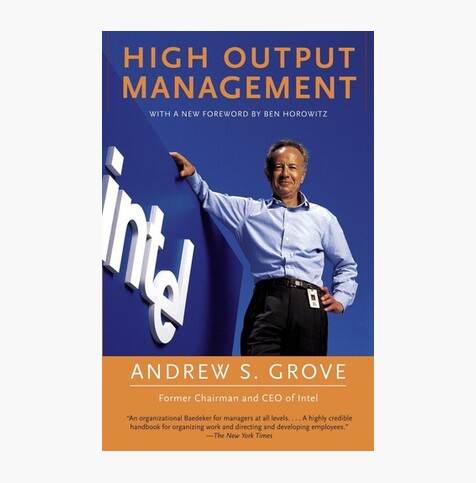
High Output Management by Andrew S. Grove is considered one of the most influential management books ever written. Written by the former CEO of Intel, this book revolutionized how business leaders understand productivity and organizational performance. Grove, recognized as one of the most successful managers in technology history, shares his practical and straightforward methodology for maximizing the output of any team or department. The book has become required reading for entrepreneurs, executives, and managers seeking to scale their organizations without losing efficiency. His concepts of leverage indicators, productive meetings, and data-driven decision-making remain completely relevant decades after publication. If you're looking to transform your management capability and take your team to the next level of performance, this book offers a proven framework from one of the world's most successful technology companies.
BOOK SUMMARY
Andrew S. Grove presents a management framework based on the fundamental principle that a manager's job is to maximize their organization's output. The book structures its teachings around three fundamental pillars:
1. Production as a System
Grove uses the analogy of a breakfast restaurant to explain how any productive operation works: all processes have an input, processing time, and output. This metaphor allows visualizing bottlenecks, optimizing workflows, and understanding where to focus improvement efforts.
2. Leverage Indicators and Measurement
The author introduces the concept of managerial leverage: a manager's activities should be evaluated based on their multiplier impact on total output. Not all tasks have equal value, and an effective manager identifies and prioritizes those with greater leverage.
3. Meetings and Decision Making
Grove classifies meetings into process-oriented (to share information) and mission-oriented (to solve specific problems). He also develops the knowledge-based decision-making model: decisions should be made by whoever possesses the relevant information, not necessarily by whoever has higher hierarchy.
Key Additional Concepts:
WHY I RECOMMEND READING THIS BOOK? By Francisco Santolo
High Output Management is one of those books that changes how you understand business management. I especially recommend it because Andrew Grove doesn't write from academic theory, but from the practice of having led Intel to become one of the world's most important companies.
What I value most about this book is its pragmatic approach. Grove doesn't tell you "be a good leader" in abstract terms; he gives you concrete tools to measure and improve your team's output. The leverage concept changed how I prioritize: I learned to identify which activities really multiply the value we generate at Scalabl.
One-on-one meetings are another practice we implemented directly. It seems simple, but having a structured space every week with each key team member transformed our communication and our ability to detect problems before they escalate.
If you're scaling a startup or managing a growing team, this book will give you a solid framework to not lose control while you grow. It's conceptually dense but practical in application. I've reread it several times and each time extract new insights depending on the stage the company is in.
My advice: read it with a pencil in hand and apply one idea per week. Don't try to implement everything at once, but do note which concepts resonate with your current challenges.
RELATED BOOKS
1. The Effective Executive - Peter Drucker
The definitive classic on executive productivity. Drucker and Grove share an obsession with measurable output and time management as a scarce resource. Excellent complement to deepen the personal effectiveness of the leader.
2. Measure What Matters - John Doerr
Expands directly on the OKR system that Grove developed at Intel. Doerr, who worked with Grove, shows how companies like Google implemented this system with extraordinary results.
3. The Hard Thing About Hard Things - Ben Horowitz
Written from the perspective of a startup CEO, it complements Grove with more extreme situations and crisis management. Horowitz cites Grove as direct influence on his thinking about management.