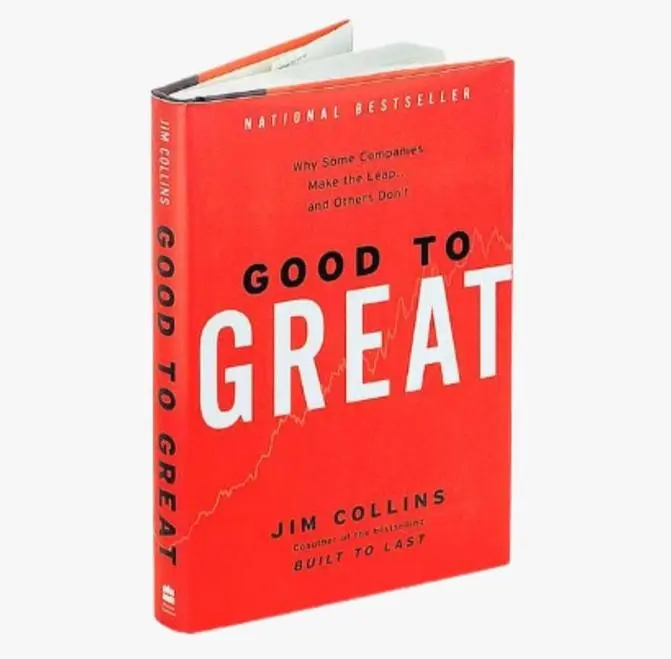
"Good to Great: Why Some Companies Make the Leap... and Others Don't" by Jim Collins is the result of a rigorous five-year investigation into companies that managed to transition from good to exceptional. Collins and his team analyzed 1,435 companies over 40 years to identify the 11 that achieved this transformation, discovering surprisingly simple yet profound patterns.
"Good is the enemy of great. Most companies don't die from lack of opportunities, but from lack of discipline. Discipline of people, discipline of thought, discipline of action." - Jim Collins
BOOK SUMMARY
Collins identifies a framework of concepts that distinguish companies that made the leap from good to great, organized into three fundamental disciplines:
Discipline of People:
1. Level 5 Leadership: Exceptional companies have leaders who combine fierce will with personal humility. These leaders aren't celebrities; they are people who attribute success to external factors and blame to themselves. Their ambition is for the organization, not for themselves.
2. First Who, Then What: Great companies get the right people on the bus (and the wrong ones off) before deciding strategic direction. With the right team, direction problems almost solve themselves.
3. Confront the Brutal Facts (Yet Never Lose Faith): The "Stockdale Paradox" (named after the admiral who survived Vietnam) involves accepting the harshest reality while maintaining absolute confidence in ultimate triumph. Great companies create cultures where truth is heard.
Discipline of Thought:
4. The Hedgehog Concept: Based on the parable of the fox (who knows many things) and the hedgehog (who knows one big thing). Exceptional companies find the intersection of three circles:
What can you be the best in the world at?
What drives your economic engine?
What are you deeply passionate about?
This intersection is the "hedgehog concept" - a simple focus that guides all decisions.
Discipline of Action:
5. Culture of Discipline: Great companies combine a culture of discipline with freedom and responsibility. They don't need bureaucracy because the right people act with discipline within a defined framework.
6. Technology as Accelerator: Great companies don't use technology as a creator of advantages but as an accelerator of their hedgehog concept. They adopt technology selectively and coherently.
7. The Flywheel Effect: The transition from good to great doesn't happen with a spectacular blow but with consistent pushes that accumulate momentum. Each push builds on the previous ones until the flywheel spins almost by itself.
This book is an invitation to stop settling for "good." Collins demonstrates that business excellence isn't about circumstances, charismatic leadership, or brilliant strategies, but about systematic discipline. It's uncomfortable to read because it forces you to confront how many times you've accepted "good enough" instead of pursuing "great."
I especially recommend it because the "Hedgehog Concept" is a brutally effective strategic tool. Many entrepreneurs want to do everything: multiple segments, multiple products, multiple channels. Collins shows you that companies that truly stand out are those that say "no" to almost everything to focus on a single thing they can do better than anyone else.
Level 5 Leadership is also revealing. In an era of celebrity CEOs, Collins demonstrates that the best leaders are the ones nobody knows. They don't seek personal recognition; they seek lasting results for the organization. It's a model of antifragile leadership: it doesn't depend on one person's charisma but on building an institution.
If you're building a company, this book helps you ask: am I building something good or something great? Do I have the right people before defining strategy? Do I have enough focus or am I spreading myself thin? The answers to these questions determine whether your company will be memorable or just another one.
Reading is the beginning. Applying is the leap.
At Scalabl you don't stop at the summary: you take the best business ideas to your own venture. Our flagship Entrepreneurship & Innovation Course: 10 years running, graduates in 50+ countries, 12 modules at your own pace.