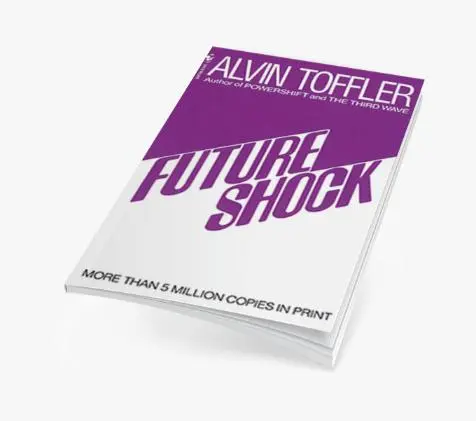
Future Shock by Alvin Toffler is one of the most influential prospective works of the 20th century. Written in 1970, Toffler anticipated with extraordinary precision phenomena we now experience as normal: information overload, accelerated obsolescence, the disposable economy, remote work, identity fragmentation, and the anxiety caused by change too rapid for humans to process. Toffler didn’t just predict the future: he diagnosed the disease of our era half a century before most recognized it.
“The illiterate of the 21st century will not be those who cannot read and write, but those who cannot learn, unlearn, and relearn.” — Alvin Toffler
BOOK SUMMARY
Toffler structures the book around a central thesis: the acceleration of change is not just an economic or technological phenomenon but a psychological one. Humans have an adaptation limit, and when change exceeds it, we experience “future shock” —disorientation, anxiety, and paralysis.
Transience: Toffler describes how relationships with things, places, people, and organizations become increasingly temporary. The economy shifts from ownership to use, from permanent to disposable, from lifetime careers to temporary jobs. What was a prediction in 1970 is now the norm.
Overchoice: More options don’t mean more freedom. Toffler anticipated that the proliferation of choices —from products to lifestyles— would generate decision paralysis and anxiety. What we now call “decision fatigue” was described by Toffler decades before the term existed.
Knowledge de-specialization: Toffler predicted that specialized knowledge would have an increasingly shorter shelf life, making the ability to learn, unlearn, and relearn more valuable than any specific degree or certification.
Social fragmentation: Subcultures multiply, identities diversify, and social consensus weakens. Toffler saw that technological acceleration would not unify humanity but fragment it into increasingly smaller and specific interest tribes.
What is most impressive about the book is not the individual predictions —many were right, some were wrong— but the analytical framework. Toffler understood that the problem of the future is not technology itself but the speed at which it transforms human relationships, institutions, and our own psychology. That framework remains as relevant today, in the age of artificial intelligence, as it was in 1970.
What impacts me most about Toffler is how he saw everything that was coming with extraordinary anticipation. At the time, he was confused with a science fiction author, when in reality he was a rigorous scientist analyzing trends with a depth few could match. Reading Future Shock today, more than 50 years later, produces a revealing sensation: practically everything he described as a future scenario is our daily reality.
The book’s central concept —future shock— is exactly what we are living through in this era, and it will only grow stronger. Human beings have an enormous difficulty comprehending exponential processes: our brains are designed to think linearly, and that makes us systematically underestimate the speed of change. Toffler understood this decades before most people could even sense it.
For entrepreneurs and leaders, this book offers a perspective that transcends tactics: understanding the deep forces transforming society. When you understand acceleration as a systemic phenomenon, you stop being surprised every time an industry transforms and start anticipating where the next wave of change will come from. In times of artificial intelligence and exponential transformation, Toffler is more relevant than ever.
I also value that Toffler was neither a naive techno-optimist nor an apocalyptic. His stance is realistic: accelerated change brings enormous opportunities but also real human costs that societies must learn to manage. That balanced view is largely missing from much of today’s discourse on innovation and technology.
Read it not as a historical book but as a lens to understand the present. Everything Toffler described accelerated with the internet, social media, and artificial intelligence. The future shock didn’t end: it intensified.
Reading is the beginning. Applying is the leap.
At Scalabl you don't stop at the summary: you take the best business ideas to your own venture. Our flagship Entrepreneurship & Innovation Course: 10 years running, graduates in 50+ countries, 12 modules at your own pace.