
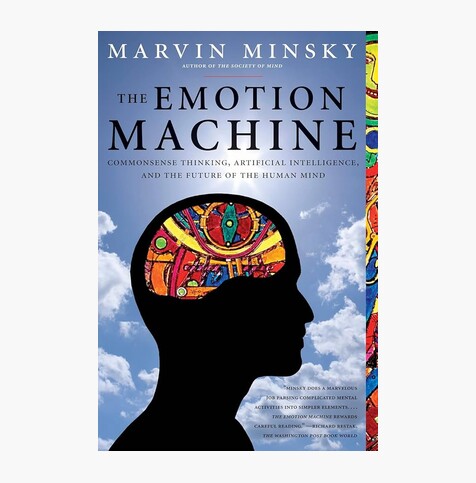
from Marvin Minsky
The Emotion Machine by Marvin Minsky is a revolutionary work that challenges the traditional conception of emotions as irrational and mysterious phenomena. Minsky, a pioneer of artificial intelligence and co-founder of the MIT Media Lab, proposes that emotions are not the opposite of reason, but rather specific forms of thinking that evolved to solve complex problems that pure logical thinking cannot address. This book is essential for entrepreneurs seeking to understand human decision-making, the design of products that connect emotionally with users, and leadership that inspires high-performance teams.
BOOK SUMMARY
Minsky presents a revolutionary theory: emotions are specialized thinking tools, not chaotic states to be suppressed. Through six levels of mental processing, he explores how the mind alternates between different modes of thinking depending on circumstances.
Key concepts:
WHY I RECOMMEND READING THIS BOOK? By Francisco Santolo
As an entrepreneur and founder of Scalabl, I find in this book an invaluable perspective for understanding one of the most underestimated aspects of business: the human factor. For years, the corporate world has tried to separate the emotional from the professional, when in reality great business decisions are always emotional decisions.
Minsky helped me understand that when an investor decides to bet on a startup, when a customer chooses our product, or when an employee decides to stay with the company, they're not applying pure mathematical logic. They're using emotional ways of thinking that evolved over millions of years.
For entrepreneurs designing products, this book is fundamental: understanding emotions is understanding the customer. For leaders, it's revealing: leading isn't about suppressing emotions, but creating contexts where the right emotions emerge naturally.
In a world where AI is transforming every industry, Minsky reminds us that the human won't be replaced by logical machines, but complemented by systems that understand the emotional complexity that defines us.
RELATED BOOKS
1. [Thinking, Fast and Slow](../thinking_fast_and_slow/) by Daniel Kahneman - Perfectly complements Minsky by exploring the two systems of human thought and their implications for decision-making.
2. [Emotional Intelligence](../emotional_intelligence/) by Daniel Goleman - A more practical approach to applying emotional knowledge in workplace and leadership contexts.
3. [Sapiens: A Brief History of Humankind](../sapiens/) by Yuval Noah Harari - Provides the evolutionary context that explains why we developed these complex forms of emotional thinking.