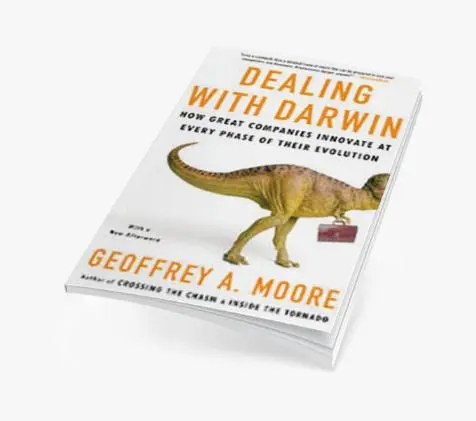
Discover how great companies can innovate at every phase of their evolution, why innovation is not one single thing, and how to choose the right type of innovation based on your market’s maturity, using Geoffrey Moore’s framework of 14 types of innovation.
“Innovation is not a single act or a uniform process. What works as innovation at one stage of the market lifecycle may be completely irrelevant at another.” — Geoffrey Moore
BOOK SUMMARY
Geoffrey Moore, one of the most influential thinkers in innovation strategy, presents in this book a comprehensive framework for understanding how companies must innovate differently depending on the lifecycle stage of their market. Moore identifies 14 distinct types of innovation —from disruptive innovation and application innovation to process innovation and organic renewal— and explains which ones are appropriate in each phase: growth, maturity, or decline.
The central thesis is that most companies fail at innovation not because they don’t innovate, but because they apply the wrong type of innovation for their context. A startup in a growth phase needs disruptive innovation; a mature company in a commoditized market needs process or customer experience innovation. Confusing these needs leads to wasted resources and organizational frustration.
Moore also addresses how to manage organizational inertia —what he calls “dealing with Darwin”—: the natural tendency of organizations to keep doing what they have always done, even when the market has already changed. The book offers concrete tools for diagnosing where your company is in the lifecycle and selecting the right innovation strategy.
Moore’s framework for understanding that innovation is not one thing is fundamental. It changes depending on where you are in the market lifecycle. This connects directly to his work in “Crossing the Chasm” and “Zone to Win,” forming a trilogy that every innovation strategist should master. At Scalabl®, we use these frameworks as constant references when helping companies define their innovation strategy.
What I find most valuable about this book is its ability to explain why what worked as innovation yesterday will not work tomorrow. Many companies get trapped repeating the formula that made them successful, without understanding that the market has already evolved and that they need a completely different type of innovation. This book provides the language and the framework to have that difficult conversation within an organization.
It is essential reading for any leader who wants to understand why their company innovates a lot but does not advance, or why innovation initiatives do not generate the expected impact. The answer is almost always that the wrong type of innovation is being applied.
Reading is the beginning. Applying is the leap.
At Scalabl you don't stop at the summary: you take the best business ideas to your own venture. Our flagship Entrepreneurship & Innovation Course: 10 years running, graduates in 50+ countries, 12 modules at your own pace.