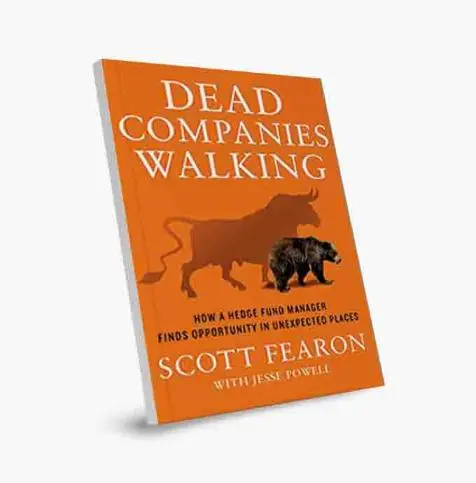
"Dead Companies Walking: How a Hedge Fund Manager Finds Opportunity in Unexpected Places" by Scott Fearon is a tale from the trenches of the short-selling investment world. Fearon managed a hedge fund for more than three decades, specializing in identifying and short-selling stocks of companies that would eventually go bankrupt. With a focus on management analysis rather than complex financial models, the book exposes why most companies that fail don't do so because of fraud, but because of preventable judgment errors.
"Most companies that go bankrupt aren't frauds or passing fads. They're common, ordinary failures, the result of bad ideas, bad management, or a combination of both. Failure is an ordinary and critical part of what makes a healthy market economy work." - Scott Fearon
BOOK SUMMARY
Fearon identifies six fatal errors committed by business leaders whose companies end up in bankruptcy. He discovered these patterns after personally analyzing more than 2,000 management teams and shorting more than 200 companies that eventually failed:
1. Historical myopia: Assuming that the recent past is the best predictor of the future. Fearon documents the case of Global Marine, whose CFO showed a 20-year chart demonstrating that their oil platform utilization never fell below 70%. 18 months later, the company was bankrupt with utilization at 25%. Long cycles (supercycles) can encompass short cycles that seem immutable.
2. Formula fallacy: Blindly trusting past success formulas. Fearon admits to having lost two of his best opportunities -Starbucks and Costco- because his GARP (Growth At Reasonable Price) formula indicated they were overvalued, ignoring their real growth potential.
3. Neglecting customers: Losing sight of who generates revenue. Executives become emotionally attached to their products and ignore the most important data: actual customer behavior. It's confirmation bias applied to business.
4. Mania victims: Falling into collective optimism that makes you believe "this time is different." Fearon documents everything from the Texas oil bubble to dot-com and the 2008 housing bubble.
5. Failure to adapt to tectonic changes: Failing to recognize when an industry has fundamentally changed. The Blockbuster example -trying to save its physical store model while Netflix redefined the business- illustrates how leaders cling to the past instead of pivoting.
6. Operational disconnection: Being physically or emotionally removed from operations. Executives in ivory towers make decisions based on reports instead of seeing the real business.
Fearon emphasizes that shorting isn't unpatriotic or malicious. Short sellers are the most cautious in the market because they face unlimited risk (a stock can rise infinitely, but only fall to zero). Identifying doomed companies requires the same rigorous analysis as finding winners.
The book also explores cases where Fearon covered short positions and even bought stocks when companies managed to reverse their course. Flexibility -not having rigid opinions- is key in investing.
This book is a masterclass in critical thinking applied to business. Fearon isn't an academic theorist; he's someone who put his money where his mouth was for 30 years. His perspective is valuable precisely because it's contrarian: while everyone looks for the next unicorn, he specialized in finding companies heading for the abyss.
I especially recommend it because it teaches you to see what others ignore. "Historical myopia" is an error I constantly see in entrepreneurs: they assume that because something worked a certain way last year, it will work the same way next year. Market cycles, technological disruptions, changes in consumer behavior -all of this invalidates models that seemed solid.
Fearon's six errors are exactly what destroy promising companies in early stages. The entrepreneur who falls in love with their solution and stops listening to their customers (error 3). The one who follows their growth "formula" to the extreme without noticing the market changed (error 2). The one who's so busy raising capital they don't notice their business model no longer makes sense (error 6).
The "formula fallacy" also resonates with me. Frameworks like the Business Model Canvas or agile methodologies can become dogmas if not used with judgment. Tools are useful, but don't replace judgment. Fearon lost millions in potential gains on Starbucks and Costco because he followed his formula instead of his instinct after meeting the executives.
If you're investing, starting a business, or managing a company, this book gives you a manual for detecting warning signs before it's too late. It's easier to learn from others' failures than your own.
Reading is the beginning. Applying is the leap.
At Scalabl you don't stop at the summary: you take the best business ideas to your own venture. Our flagship Entrepreneurship & Innovation Course: 10 years running, graduates in 50+ countries, 12 modules at your own pace.
by Michael Lewis The story of the investors who anticipated the 2008 subprime crisis. Complements Fearon with a macroeconomics perspective and how entire financial systems can be built on faulty foundations.
Fiasco: The Inside Story of a Wall Street Frank Partnoy
Fiasco: The Inside Story of a Wall Street Trader
Frank Partnoy
by Frank Partnoy Stories from a derivatives trader who documents how Wall Street creates complex products that not even their creators fully understand. An inside view of financial excesses.
Margin of SafetySeth Klarman
Margin of Safety
Seth Klarman
by Seth Klarman The value investing book that became a cult classic. Klarman, like Fearon, emphasizes risk management and the importance of not losing money over making it.
Let's talk
Leave your details and the team will contact you.
📚
LucíaBusiness Library · Scalabl®
What is your name? What are you looking to learn these days?