
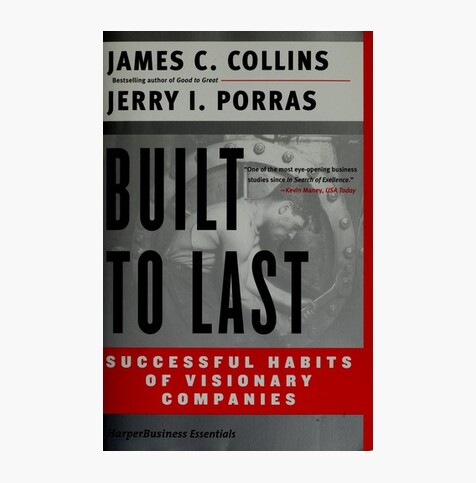
from Jim Collins & Jerry I. Porras
What makes certain companies not only succeed but endure for decades or even centuries? Jim Collins and Jerry Porras spent six years researching 18 visionary companies (HP, 3M, Disney, Walmart, Sony, among others) to discover the patterns that distinguish them from their competitors. The result is a rigorous empirical study that dismantles deeply rooted myths about business success.
"Building a visionary company requires 1% vision and 99% alignment." — Jim Collins & Jerry Porras
BOOK SUMMARY
Collins and Porras compared "visionary" companies with their direct competitors of similar size and industry during the period 1926-1990. The visionary companies outperformed the general market by more than 15 times. The surprising finding: it wasn't the quality of their products, the charisma of their leaders, or a great initial idea that made them triumph.
The core principles of visionary companies:
1. Clock Building, Not Time Telling: Founders of visionary companies concentrate on building organizations that endure, not on being individual visionaries or having a great idea. Their greatest creation is the institution itself, not a specific product. This allows them to survive generations of leaders, product cycles, and even the extinction of their original markets.
2. The Genius of the AND: Visionary companies reject the "Tyranny of the OR." They don't choose between stability OR innovation, profit OR purpose, tradition OR change. They find ways to embrace both extremes simultaneously. Example: 3M maintains conservative structures while fostering radical innovation.
3. Preserve the Core / Stimulate Progress: This is the most fundamental pattern. Visionary companies maintain their core ideology (values and purpose) absolutely immutable, while stimulating constant changes in everything else: strategies, practices, structures. The tension between preservation and progress is what keeps them vibrant.
4. Big Hairy Audacious Goals (BHAGs): Audacious, clear, and comprehensible goals that push the organization beyond its comfort zone. Examples: "A flight to the moon before 1970" (NASA), "Democratize the automobile" (Ford), "A computer on every desk" (Microsoft). BHAGs stimulate progress without abandoning core values.
5. Cult-Like Cultures: Not cults in the negative sense, but with unusual intensity. Their values are real, not decorative. They hire people who fit the culture and fire those who don't, regardless of individual talent. The extreme example: Disney, where employees are "cast members," not workers.
6. Try a Lot of Stuff and Keep What Works: Visionary companies don't rely on detailed strategic planning. Many of their best products emerged by accident, experimentation, and opportunism. What distinguishes them is their ability to recognize opportunities and scale them rapidly.
7. Home-Grown Management: They prioritize promoting from within. This ensures cultural continuity and aligns leaders with core values. Only 4 of 113 CEOs in visionary companies were hired from outside.
8. Good Enough Never Is: They maintain an insatiable continuous improvement. They don't compare themselves to competitors; they compare themselves to themselves. Their goal is not to be better than others, but to be better than they were yesterday.
WHY I RECOMMEND READING THIS BOOK? By Francisco Santolo
This book is an antidote against the current obsession with "hustle," founder charisma, and the search for the big disruptive idea. Collins and Porras demonstrate with hard data that companies that truly endure don't depend on brilliant individuals or revolutionary ideas. They depend on systems designed to survive and thrive regardless of who's in charge.
I especially recommend it because it dismantles harmful myths:
The concept of "Clock Building, Not Time Telling" transformed my perspective on entrepreneurship. Many founders want to be the star; builders of visionary companies want to build a machine that works without them. This architectural humility is rare and valuable.
The "Genius of the AND" is particularly relevant today, where we see false dichotomies everywhere: remote or in-person? AI or humans? Growth or profitability? Visionary companies find ways to say "yes, and both." They don't simplify; they embrace creative tension.
For those building companies intended to last, this book is not optional. It's a manual on how to think in decades rather than quarters, in institutions rather than products, in immutable values rather than ephemeral tactics.
RELATED BOOKS
"Good to Great" by Jim Collins
The logical continuation. If "Built to Last" studies what makes companies enduring, "Good to Great" explores how ordinary companies make the leap to extraordinary results. The concept of the "hedgehog concept" and Level 5 leaders perfectly complement the vision of institutional building.
"The Innovator's Dilemma" by Clayton Christensen
Christensen explains why successful companies can fail in the face of disruptive innovations. Read alongside "Built to Last," it provides a complete vision: how to build enduring companies while navigating the dangers of innovation that can destroy them.
"Scalable Freedom" by Francisco Santolo
For a contemporary perspective on how to build companies designed to scale without depending on the founder's constant presence, applying systematization principles to modern businesses.