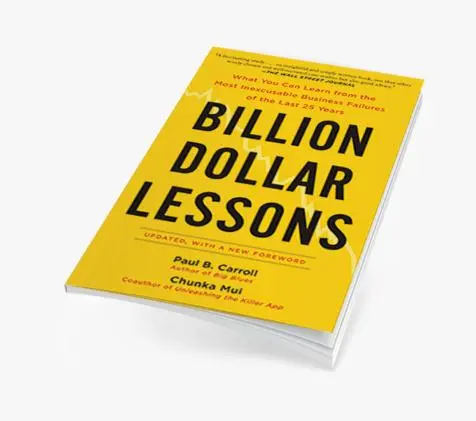
Billion Dollar Lessons by Paul B. Carroll and Chunka Mui is a revealing analysis of the most costly business failures of recent decades. Through the systematic study of failed strategies, synergy illusions, and technology mirages, the authors demonstrate that learning from failure is often more valuable than studying success.
“The most costly business failures follow surprisingly predictable patterns. The tragedy is not that they happen, but that they repeat themselves over and over again.” — Paul B. Carroll & Chunka Mui
BOOK SUMMARY
Carroll and Mui undertake a monumental research effort: they analyze hundreds of business failures that together represent billions of dollars in destroyed value. What they discover is both revealing and disturbing: the patterns of failure repeat with astonishing regularity. Companies that overpaid for acquisitions believing in synergies that never materialized, those that bet everything on technologies that turned out to be mirages, those that attempted to expand into adjacent markets without understanding the fundamental differences. Each chapter dissects a specific pattern of failure with real, detailed cases.
The book identifies seven main categories of failed strategies: value-destroying consolidations, expansions into adjacent markets without real competencies, premature technology bets, illusory synergies in mergers, attempts to ride trends without competitive advantage, holding onto obsolete assets for too long, and excessive optimism in projections. The authors not only document these failures but propose a practical framework for detecting warning signs before it is too late. The most powerful lesson of the book is that most of these disasters were avoidable if someone had asked the right questions at the right time.
While most business books focus on success stories, this one studies spectacular failures —and that makes it incredibly valuable. The patterns of failure are surprisingly repetitive: companies that overpaid for acquisitions, bet on synergies that never materialized, or blindly followed technology trends without evaluating whether they had a real competitive advantage. Understanding these patterns helps avoid them, and that can be the difference between building something lasting and destroying value.
At Scalabl® we firmly believe that the study of failure is as important as the study of success. In fact, patterns of failure are more reliable as a guide than patterns of success, because success has luck components that are difficult to replicate, while failure tends to follow well-signposted paths. This book is a map of those dangerous paths. For any entrepreneur or executive considering an important acquisition, an expansion into new markets, or a significant technology bet, reading these lessons before deciding can save not only money, but years of misdirected effort.
Reading is the beginning. Applying is the leap.
At Scalabl you don't stop at the summary: you take the best business ideas to your own venture. Our flagship Entrepreneurship & Innovation Course: 10 years running, graduates in 50+ countries, 12 modules at your own pace.