
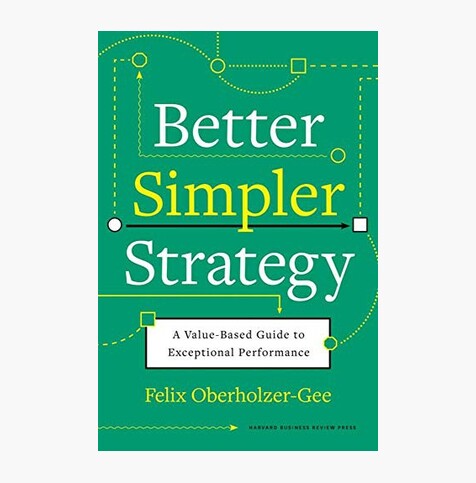
from Felix Oberholzer-Gee
"Better, Simpler Strategy" by Felix Oberholzer-Gee is a revolutionary work that challenges the unnecessary complexity dominating contemporary strategic thinking. Published in 2021, this book offers a surprisingly simple yet profoundly effective framework for creating value and capturing benefits in any industry. Oberholzer-Gee, a professor at Harvard Business School, argues that most companies get lost in complex analyses, positioning matrices, and intricate strategic plans, when successful strategy really boils down to answering two fundamental questions: How much are you willing to pay for our product? (Willingness to Pay) and How much are you willing to accept to work here? (Willingness to Sell). For entrepreneurs, executives, and strategy consultants, this book is invaluable because it provides a common language and clear metrics for making strategic decisions, evaluating initiatives, and communicating value to stakeholders. In a world where strategic clarity is a competitive differentiator, this book offers a simple but powerful compass for navigating business complexity.
BOOK SUMMARY
The central framework of the book is based on the concept of Value defined as:
Value = Willingness to Pay (WTP) - Cost of product + Opportunity cost to customer - Willingness to Sell (WTS)
Willingness to Pay (WTP): The maximum price a customer would be willing to pay for a product or service. Increasing WTP is creating value for customers.
Willingness to Sell (WTS): The minimum compensation an employee, supplier, or partner would accept. Reducing WTS is creating value for stakeholders.
The Value Equation: The total value created is distributed among customers (through WTP), the company (profits), and employees/suppliers (through WTS).
1. Increase WTP through differentiation, superior quality, customer experience, brand, and personalization
2. Reduce WTS by creating an attractive workplace, operational efficiency, and win-win relationships with suppliers
3. Eliminate activities that don't create value by identifying where value is lost in the chain
Oberholzer-Gee demonstrates through numerous case studies (IKEA, Starbucks, Amazon) that the most successful companies are those that maximize value created for all stakeholders, not just shareholders.
WHY I RECOMMEND READING THIS BOOK? By Francisco Santolo
As an entrepreneur who has founded multiple companies and mentored hundreds of startups, "Better, Simpler Strategy" has given me the most practical and applicable framework I've found for business strategy. What I value most is that it demystifies strategy: you don't need to be a McKinsey consultant to develop a winning strategy.
This book is particularly useful for founders because:
1. Eliminates analysis-paralysis: Instead of getting lost in complex frameworks, it gives you two clear metrics to evaluate any decision
2. Customer-oriented: It forces you to constantly think about how you increase perceived value for your customers
3. Balances stakeholders: It reminds you that sustainable success requires creating value not just for customers, but also for employees and partners
4. It's actionable: Each chapter includes practical tools you can implement immediately
I especially recommend this book to growth-stage startups trying to find their strategic positioning and established companies that feel their strategy has become too complex. It's a powerful antidote against "PowerPoint strategy" that fills slides but doesn't generate results.
RELATED BOOKS
1. "Good Strategy Bad Strategy" - Richard Rumelt: The definitive book on what separates effective strategies from those that just sound good, perfectly complements Oberholzer-Gee's practical approach.
2. "The Outsiders" - William Thorndike: Analyzes how exceptional CEOs made simple but counterintuitive capital and strategy decisions that generated extraordinary returns.
3. "Playing to Win" - A.G. Lafley and Roger Martin: P&G's strategy cascade framework offers a complementary structure for implementing Oberholzer-Gee's value management ideas.