
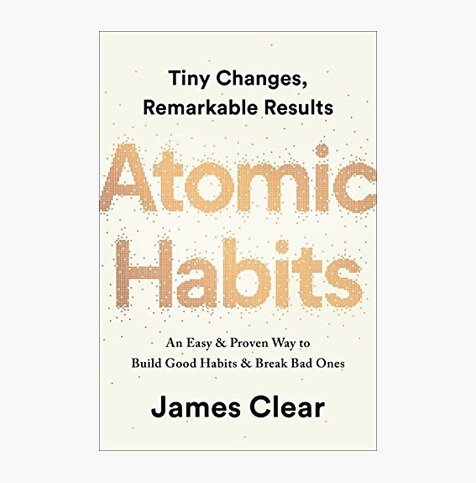
from James Clear
Why do we repeat behaviors we know harm us? James Clear, a habit formation expert, demonstrates that the problem isn't lack of willpower, but lack of correct systems. "Atomic Habits" offers a practical framework based on neuroscience and behavioral psychology to build positive habits and eliminate negative ones through minimal but consistent changes. The book has sold over 25 million copies and has been translated into more than 50 languages.
"You do not rise to the level of your goals. You fall to the level of your systems." — James Clear
BOOK SUMMARY
Clear structures the book around a fundamental model: every habit goes through four stages—cue, craving, response, and reward—and provides specific laws to optimize each stage.
The four pillars of habit change:
1. Make It Obvious (1st Law): Habits begin with visible cues.
- Implementation intention: Specify when, where, and how: "I will [BEHAVIOR] at [TIME] in [LOCATION]"
- Habit stacking: Link a new habit to an existing one: "After [CURRENT HABIT], I will [NEW HABIT]"
- Environment design: Modify your physical space so that cues for good habits are visible and cues for bad habits are invisible
2. Make It Attractive (2nd Law): Habits persist when we anticipate reward.
- Temptation bundling: Pair something you need to do with something you want to do (e.g., only listen to favorite podcasts while exercising)
- Role of dopamine: Anticipation of reward generates more motivation than the reward itself
- Social culture: We join groups where desired behavior is the normal behavior
3. Make It Easy (3rd Law): Friction determines action.
- The Two-Minute Rule: Any new habit should take less than two minutes at the start (e.g., "put on running shoes" instead of "run 5 km")
- Friction reduction: Remove obstacles for good habits; add obstacles for bad ones
- Automation: Use technology to make desired habits inevitable
4. Make It Satisfying (4th Law): Immediate pleasure reinforces repetition.
- Habit tracking: Visually mark your progress ("don't break the chain")
- Accountability: Create immediate consequences for non-compliance (e.g., give money to a cause you hate if you fail)
- Immediate rewards: Associate instant gratification with long-term habits
Additional key concepts:
Identity vs. outcomes: Identity-based habits are more durable than outcome-based habits. Not "I want to quit smoking" (outcome-based), but "I'm not a smoker" (identity-based). Every action you take is a vote for the type of person you're becoming.
The Plateau of Latent Potential: Results are not linear. For weeks or months you may see few visible changes while progress accumulates beneath the surface. Most people quit in the "valley of disappointment" just before the inflection point.
Systems vs. goals: Goals are for setting direction; systems are for making progress. Winning a championship is a goal; training every day is a system. Winners and losers have the same goals; what differs are their systems.
The power of 1%: Improving 1% every day makes you 37 times better in a year. Declining 1% every day takes you nearly to zero. Habits are the compound interest of self-improvement.
WHY I RECOMMEND READING THIS BOOK? By Francisco Santolo
This book is a masterful operationalization of something we all know intuitively but rarely execute: that small, consistent changes generate extraordinary results over time. Clear doesn't sell empty motivation; he sells specific systems that work without relying on willpower.
I especially recommend it because it attacks the myth of "radical change." The self-help industry promises overnight transformations. Clear demonstrates that this is harmful: it sets unrealistic expectations that lead to failure and guilt. The reality is that real change is boring, gradual, and invisible for a long time. Accepting that is liberating.
The concept of "identity change" is particularly powerful for entrepreneurs. Not "I want to build a $1M business," but "I'm someone who solves customer problems every day." Identity determines habits; habits determine results. Working outside-in (results ? identity) is exhausting. Working inside-out (identity ? results) is sustainable.
The "Two-Minute Rule" changed how I approach large projects. Every overwhelming project breaks down into a first ridiculously small action: not "write the book," but "write one sentence." Initial friction is what kills action; eliminating that friction with 2-minute actions generates momentum.
For anyone who has repeatedly failed implementing changes—whether in health, productivity, finances, or relationships—this book offers the correct diagnosis: the problem isn't you. The problem is your system. And systems can be designed.
RELATED BOOKS
"The Power of Habit" by Charles Duhigg
The book that popularized the science of habits before Clear. Duhigg delves deeper into the neurology of habit (basal ganglia) and offers business case studies. Perfectly complements Clear with a more academic perspective.
"Tiny Habits" by BJ Fogg
The Stanford researcher who inspired many of Clear's concepts. Fogg emphasizes even more the importance of starting ridiculously small and celebrating "victories." His "Anchor-Behavior-Celebration" method is practical and effective.
"Deep Work" by Cal Newport
For those who want to take atomic habits into the realm of productive work. Newport teaches how to build deep concentration habits in a world of constant distractions.