
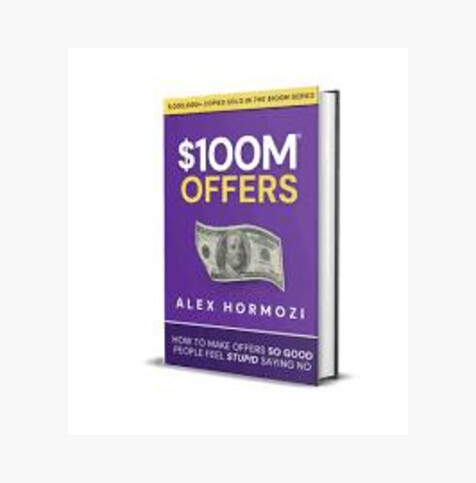
from Alex Hormozi
How do you transform a business from $0 to millions in months without initial capital or investors? Alex Hormozi did it twice, and in this book he reveals the exact system he used. "$100M Offers" isn't academic theory: it's a field manual written by someone who went from having $1,036 in his bank account to generating $1.5 million monthly in less than a year. His method: build offers so irresistible that prospects feel it would be foolish to reject them.
"The secret isn't in selling better. It's in making offers so good that selling becomes easy." — Alex Hormozi
BOOK SUMMARY
Hormozi begins by telling his personal story: Christmas 2016, with $1,036 in the bank after a partner stole $45,700 and a payment processor held $120,000. Using a credit card with a $100,000 limit, he launched six gyms simultaneously. January 2017: $100,000 in revenue. December 2017: $1.5 million monthly. His secret wasn't better marketing or aggressive sales. It was a "Grand Slam Offer."
The fundamental principles of the book:
1. The Success Hierarchy: Market > Offer > Persuasion. Most entrepreneurs spend years improving closing skills while ignoring they're in a terrible market. A market with "massive pain" + purchasing power + easy to target + growing is more important than any closing technique.
2. The Commodity Problem: If you sell a product available in many places, you compete only on price. Margins trend to zero. The solution: sell in a "category of one" where the customer's decision is between your offer and nothing.
3. The Value Equation: Value = (Dream Outcome × Perceived Likelihood) ÷ (Time Delay × Effort & Sacrifice). To maximize perceived value: increase the dream outcome and its perceived likelihood; decrease the time to result and effort required. If the denominator approaches zero, value approaches infinity.
4. The 5 Steps to Build a Grand Slam Offer:
- Step 1: Identify the customer's dream outcome (don't sell gym, sell weight loss)
- Step 2: List all obstacles the prospect faces before, during, and after
- Step 3: Convert each obstacle into a solution
- Step 4: Define delivery vehicles using the "Delivery Cube" (one-to-one, small group, one-to-many × client effort × medium × format)
- Step 5: Consolidate: trim costly low-value elements, stack high-value ones
5. The Virtuous Cycle of Price: Higher prices = more emotionally committed customers = better attention = better results = lower churn rates = higher margins = ability to improve service. Lower prices generate the opposite cycle.
6. The 5 Tools to Enhance Offers:
- Scarcity: Limit supply (total capacity, growth rate, cohort caps)
- Urgency: Limit time (seasonal promotions, bonus deadlines)
- Bonuses: Stack components as separate additions
- Guarantees: Reverse risk (unconditional, conditional, anti-guarantees, implied)
- Naming: Use the M-A-G-I-C formula (magnetic reason why + target avatar + goal + time interval + container word)
7. Never discount the main offer: Instead of lowering prices, increase perceived value by adding bonuses. A wine study demonstrated that the same beverage tasted significantly better when participants believed it was more expensive.
WHY I RECOMMEND READING THIS BOOK? By Francisco Santolo
This book is pure executable. Hormozi doesn't come from academic theory or giving conferences: he comes from real hunger, from going bankrupt, from rebuilding from scratch twice. His methodology is proven in gyms, dentists, plumbers, dog walkers, software. It's universal because it attacks universal problems.
I especially recommend it because it dismantles the "sell cheaper to compete" mentality. That race to the bottom destroys margins and quality. Hormozi demonstrates that when you increase prices radically, you increase perceived value, customer commitment, and your margins to deliver real results. It's counterintuitive but mathematically solid.
The "value equation" is an exceptional framework. It forced me to rethink how we communicate our offers at Scalabl. Are we maximizing the dream outcome? Are we eliminating perceived friction (time and effort)? Most businesses focus on features; Hormozi forces you to focus on outcomes.
The concept of "market > offer > persuasion" is a hierarchy that saves years of frustration. Many entrepreneurs master closing techniques while selling to a dying or non-purchasing market. It's like being an excellent pilot in a plane without an engine. Hormozi forces you to validate the market first.
For anyone selling anything (product, service, consulting), this book is an operational manual. Not theory: specific steps to build offers that sell themselves.
RELATED BOOKS
"$100M Leads" by Alex Hormozi
The direct continuation. If "$100M Offers" teaches how to build irresistible offers, "$100M Leads" teaches how to get prospects for those offers. Both books together form a complete customer acquisition system.
"Influence: The Psychology of Persuasion" by Robert Cialdini
The principles of reciprocity, scarcity, and social proof that Hormozi uses are grounded in Cialdini's research. This book provides the scientific basis behind Hormozi's tactics.
"The 22 Immutable Laws of Marketing" by Al Ries and Jack Trout
Perfectly complements by delving into how to position products in the consumer's mind to avoid the commodity trap.